TL;DR: Cross-border Amazon keyword research requires more than translation; it demands cultural, linguistic, and behavioral localization. This guide walks you through a 7-step workflow using SellerSprite to build high-converting keyword sets for Amazon Europe and Japan.
Key Takeaways
- Cross-border keyword research is not about translating US keywords; it's about localizing intent, language, and buyer behavior for each marketplace.
- Amazon Europe and Japan have fundamentally different search behaviors: Europe demands multilingual precision, while Japan favors short, trust-driven queries in native script variants.
- Use SellerSprite to expand local keywords, reverse-engineer competitor visibility, and validate real demand via SERP analysis, which is critical for both organic SEO and PPC success.
Table of Contents
- Why Cross-Border Keyword Research Is Different (Europe vs. Japan)
- What Changes by Marketplace (EU vs. JP): Search Behavior and SERP Reality
- Set Your Target Markets, Goals, and Constraints
- The Step-by-Step Cross-Border Keyword Research Workflow
- Europe Deep Dive: Localization Rules That Actually Move Rankings
- Japan Deep Dive: Kana/Kanji Variants, Short Queries, and Trust Signals
- Common Pitfalls (Why Cross-Border Keywords Fail)
- Mini Walkthrough: One Product → EU + JP Keyword Sets (Template)
- Ongoing Optimization: How to Keep Local Keywords Fresh
- FAQ
- References
Why Cross-Border Keyword Research Is Different (Europe vs. Japan)
Selling on Amazon in Europe or Japan isn't just about listing your product in another language. It's about understanding how buyers in those regions search, what they trust, and how Amazon's algorithm ranks content locally.
Definition: Cross-border keyword research is the process of identifying high-intent, locally relevant search terms in non-US Amazon marketplaces by analyzing language, culture, buyer behavior, and SERP dynamics, rather than translating English keywords.
The core differences: language, intent, culture, and marketplace norms
Amazon's global marketplaces are not monolithic. A product that sells well in the US may underperform in Germany or Japan, not because of quality, but because of mismatched keyword strategy.
In Europe, language fragmentation means you must tailor keywords to each country, even within the EU. In Japan, search behavior is concise, trust-based, and highly sensitive to phrasing and script usage (Kanji vs. Katakana). Cultural norms influence everything from product naming to warranty expectations.
The biggest mistake: direct translation instead of localization
Many sellers make the fatal error of translating their US keywords verbatim into German, French, or Japanese. This leads to "false friends", which means words that look correct but carry different meanings or zero search volume.
For example, translating "wireless earbuds" directly into Japanese as "ワイヤレスイヤーバuds" (using English loanwords) might seem logical, but local buyers often search using shorter, native terms like "Bluetoothイヤホン" or even just "イヤホン" with implied wireless context. Direct translation misses real demand.
What Changes by Marketplace (EU vs. JP): Search Behavior and SERP Reality
Amazon's search algorithms adapt to local user behavior. What works in one marketplace can fail in another due to differences in language structure, mobile usage, and ad competition.
Europe: multiple languages, mixed buying habits, and cross-country overlap
As of 2026, Amazon operates 10 distinct European marketplaces: UK, Germany, France, Italy, Spain, Netherlands, Poland, Sweden, Belgium, and Ireland. Many of them have their own language, search habits, and regulatory environment.
While some German buyers may understand English product titles, relying on them reduces discoverability. Localized keywords in German (DE), French (FR), or Italian (IT) are essential for ranking.
UK vs. DE vs. FR vs. IT vs. ES: naming differences that change demand
Even similar products have different naming conventions:
- UK: "torch" (not flashlight)
- DE: "Taschenlampe" (direct), but also "LED Lampe" for tech appeal
- FR: "lampe torche" – note the reversed word order
- IT: "torcia elettrica" – literal "electric torch"
- ES: "linterna" – no reference to "flash" or "light"
Using the wrong term means low or zero visibility, even if your product is perfect.
Japan: short queries, strict naming, and heavy trust signals
Japanese Amazon users tend to use very short, high-intent queries. They rely heavily on brand names, trust badges, and precise technical specifications.
Titles must be concise and use correct script forms. Overly long or awkwardly translated titles hurt conversion.
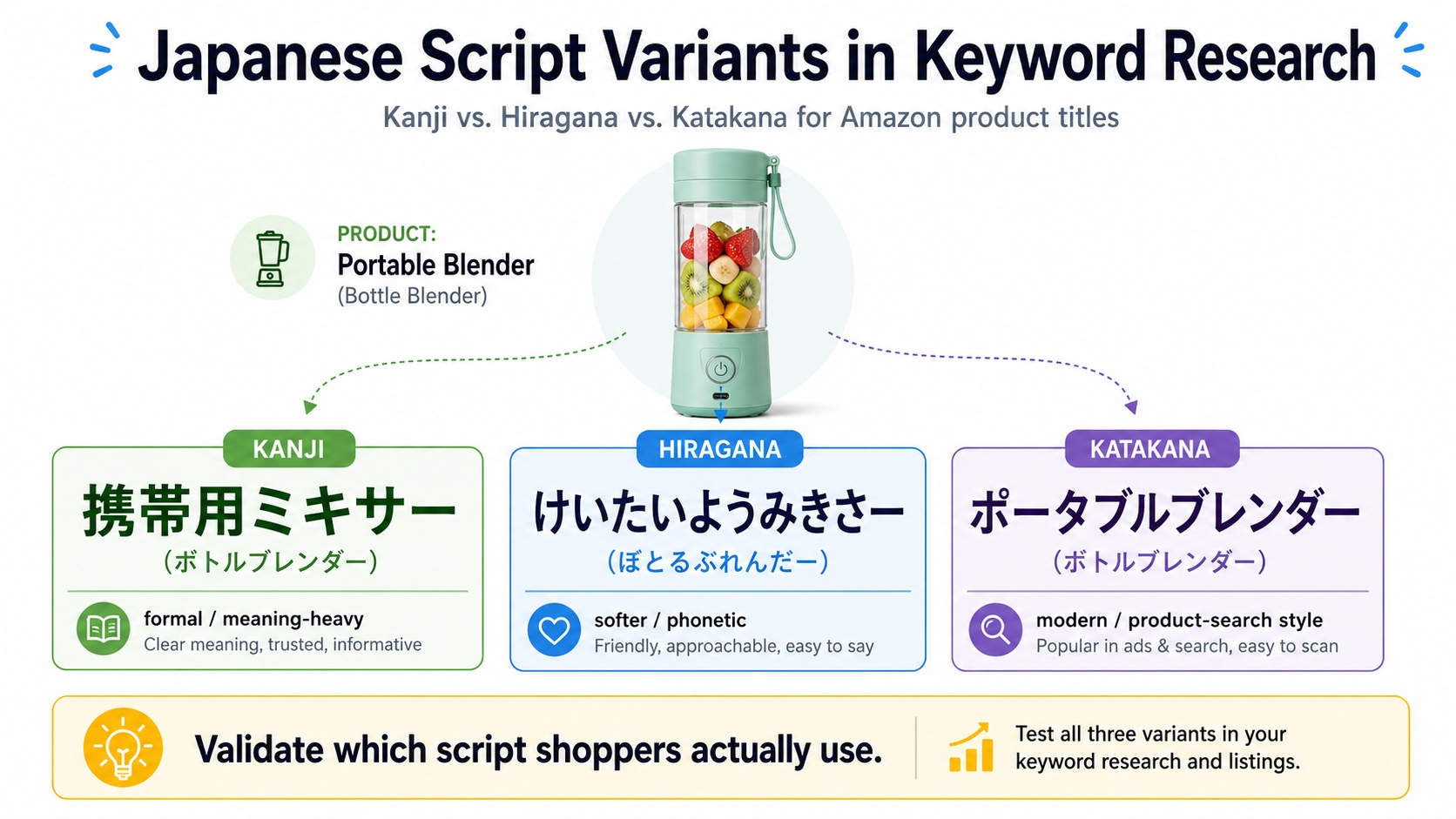
Kana/Kanji variations and why they matter
Japanese uses three scripts: Kanji (Chinese characters), Hiragana (native syllabary), and Katakana (for foreign words). The choice affects searchability:
- Kanji: Preferred for technical terms (e.g., 充電式 for "rechargeable")
- Katakana: Used for brand names or imported tech (e.g., ブルートゥース)
- Hiragana: Used in casual or descriptive phrases
Using the wrong script can make your listing invisible or appear unprofessional.
Mobile-first behavior and how it affects keyword selection
Over 70% of Amazon shoppers' searches occur on mobile devices. This means shorter queries, faster scrolling, and higher reliance on images and bullet points.
Keywords must be concise. Long-tail phrases are less common. Instead, focus on high-intent core terms like "Bluetoothイヤホン 防水" (waterproof Bluetooth earbuds).
Ad pressure differences (CPC, sponsored density, brand dominance)
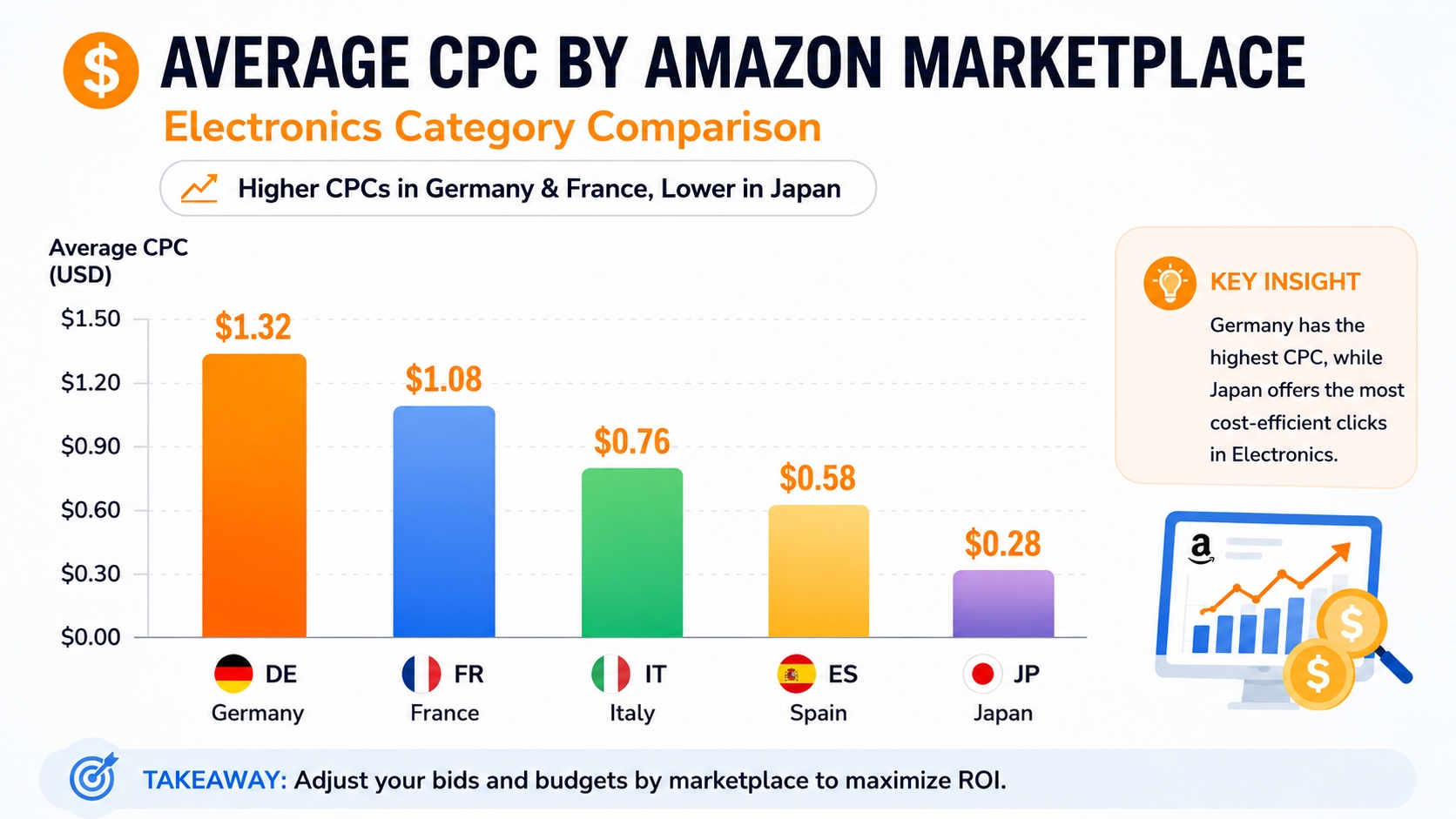
Amazon Germany has some of the highest CPCs in Europe (up to $1.80 for electronics), while Japan sees lower average bids but higher brand dominance in top positions.
In Japan, winning organic visibility is often more critical than PPC due to limited ad real estate and consumer preference for established brands.
Set Your Target Markets, Goals, and Constraints
Before researching keywords, define your strategy. Blind expansion leads to wasted effort and poor ROI.
Choose the marketplaces (EU: UK/DE/FR/IT/ES/NL/SE/PL; JP)
Prioritize based on demand, competition, and logistics. Conduct a comprehensive market research to identify high-opportunity regions.
Define your goal: launch learning vs. profitability vs. category expansion
- Launch learning: Focus on broad visibility and feedback
- Profitability: Target high-converting, low-CPC keywords
- Category expansion: Build authority with mid-tail terms
Build your product constraints checklist
Compliance/claims sensitivity by region
EU bans certain health claims unless clinically proven. Japan requires JIS certification for electronics. These affect which keywords you can safely use.
Size/plug/voltage standards (especially EU/JP electronics)
A US plug (Type A) won't work in Germany (Type F) or Japan (Type B). Include keywords like "EU Stecker" or "日本対応" to signal compatibility.
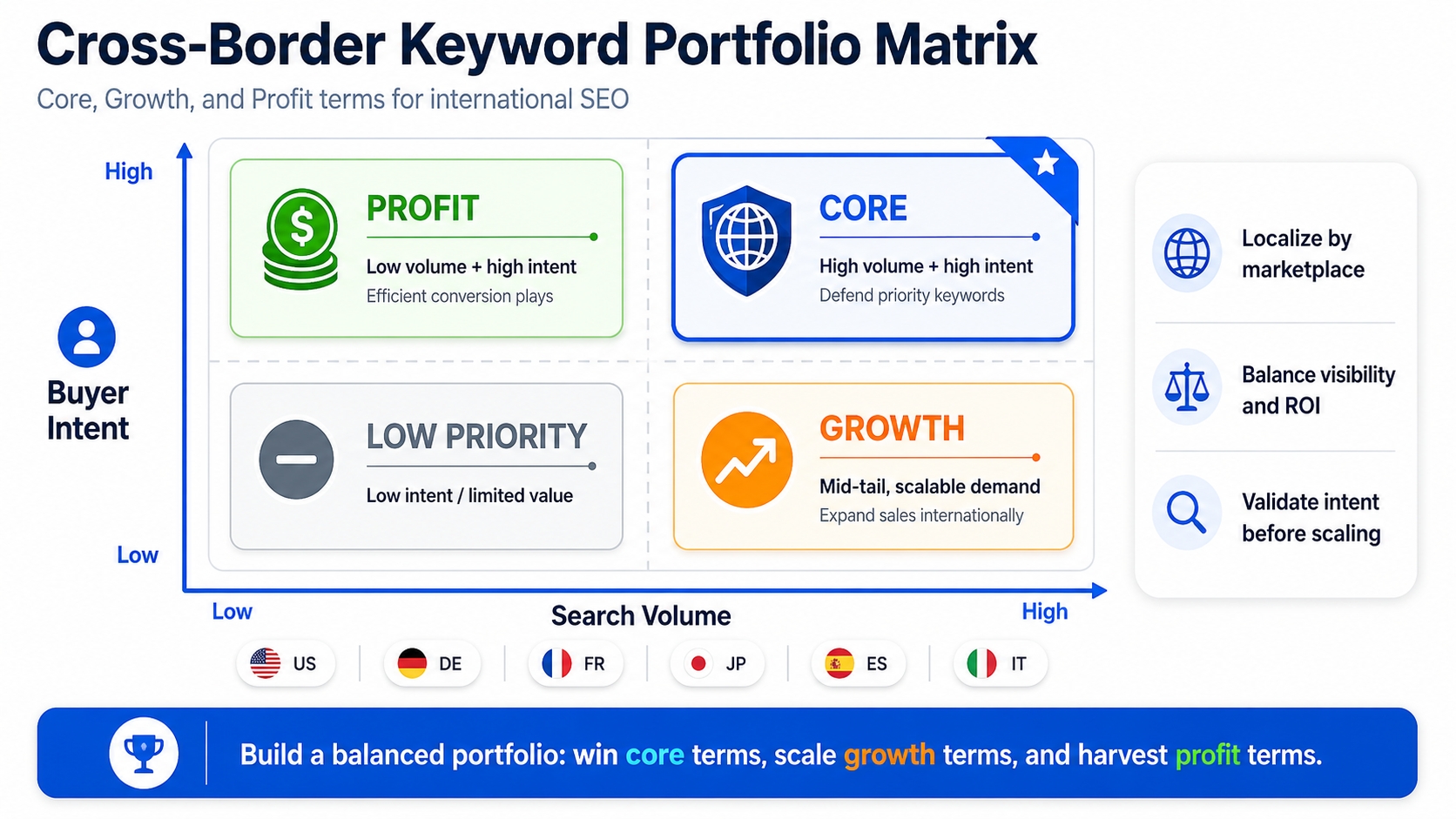
Create your keyword portfolio buckets
Core terms (must-win)
High-volume, category-defining terms (e.g., "Bluetooth Kopfhörer" in DE).
Growth terms (mid-tail)
Specific use cases or features (e.g., "kabellose Kopfhörer für Joggen").
Profit terms (long-tail/high intent)
Low competition, high conversion (e.g., "noise cancelling Kopfhörer mit Mikrofon SilentPro").
The Step-by-Step Cross-Border Keyword Research Workflow
Follow this 7-step workflow to build localized keyword sets for Amazon Europe and Japan using SellerSprite Keyword Mining.
Mini SOP: Cross-Border Keyword Workflow
- Start with local buyer language
- Build a translation map with back-translation QA
- Expand locally using SellerSprite
- Validate on local SERPs
- Cluster by intent
- Localize listing placement
- Adapt PPC strategy per marketplace
Step 1: Start With Local Buyer Language (Not English)
Collect local naming variants (what the product is called locally)
Don't assume "portable blender" translates directly. In Germany, it's "Pflanzenmixer" or "Mixer unterwegs." In Japan, "携帯用ミキサー" or "ポータブルミキサー."
Collect local modifiers (size, material, pack, compatibility, "for…" use cases)
Germans search for "BPA-frei," "edelstahl," or "für Smoothies." Japanese buyers look for "静音" (quiet), "軽量" (lightweight), or "アウトドア用" (for outdoor use).
Watch for "false friends" (words that translate but mean something else)
"Gift" in German means "poison." "Actual" in French means "current." Always validate with native speakers.
Step 2: Build a Translation Map (English → Local → Back-Translation QA)
| English Term | Local Term (DE/FR/JP) | Back-Translation | Notes |
|---|---|---|---|
| Wireless Earbuds | Bluetooth-Kopfhörer | Bluetooth Headphones | Accurate, preferred in DE |
| Portable Blender | 携帯用ミキサー | Portable Mixer | Validated by native speaker |
Use multiple translation inputs (human review strongly recommended)
Combine machine translation (Google Translate) with native speaker input to ensure your final keyword inputs are accurate.
Back-translate to confirm meaning and intent
Ensure the local term, when translated back, matches the original intent.
Create a final "approved term list" (don't improvise later)
This becomes your single source of truth for listings and ads.
Step 3: Expand Locally Using SellerSprite Keyword Research
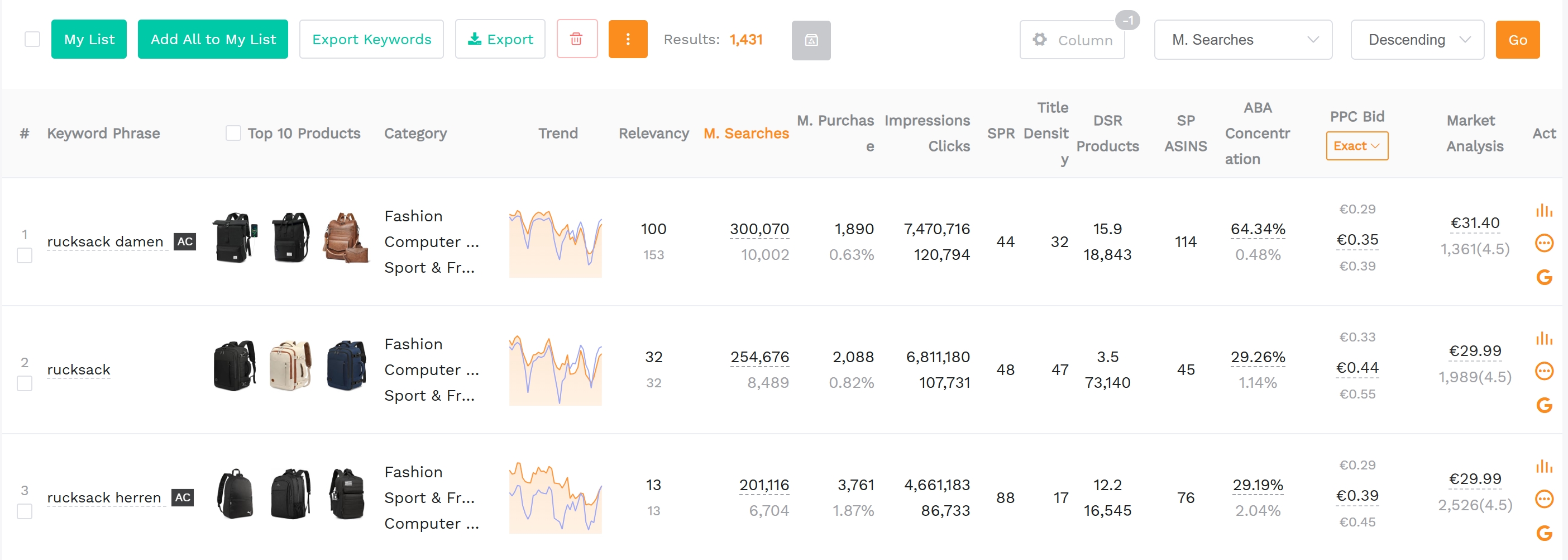
Keyword Mining: uncover long-tail modifiers in each language
Use SellerSprite Keyword Mining tool to find phrases like "wasserdichte Bluetooth-Kopfhörer für Schwimmen" (DE) or "Bluetoothイヤホン 片耳" (JP).
Reverse ASIN: see how local competitors get visibility
Open SellerSprite Reverse ASIN tool, and then enter top-selling ASINs in DE or JP to extract their keyword strategies.
Output: a master keyword sheet per marketplace
Export and organize by volume, competition, and intent.
Step 4: Validate on Each Local Amazon SERP (Reality Check)
SERP Validation Checklist:
- ✅ Autocomplete matches local phrasing?
- ✅ Top results match your product type?
- ✅ Brand dominance low enough to compete?
- ✅ Sponsored ads crowding organic results?
Autocomplete check (local suggestions reveal real phrasing)
Search your keyword on Amazon.de or Amazon.co.jp to see real-time suggestions.
SERP-fit test (do top results match your exact product type?)
If top results are bundles or accessories, your keyword may be misaligned.
Review moat + brand dominance check (winnability)
Assess whether top listings have 1000+ reviews or are branded (e.g., Sony, Braun).
Step 5: Cluster Keywords by Intent (Per Marketplace)
| Intent Type | Example (DE) | Example (JP) |
|---|---|---|
| Core Category | Bluetooth Kopfhörer | Bluetoothイヤホン |
| Use Case | für Joggen | 運動用 |
| Compatibility | für iPhone | iPhone対応 |
Step 6: Localize the Listing Keyword Map (SEO Placement Rules)
Title: primary term + key attribute early (local word order matters)
In German, place the noun first: "Bluetooth Kopfhörer, kabellos, noise cancelling."
Bullets: one intent cluster per bullet (native phrasing, not literal translation)
Each bullet should answer a buyer's question in natural language.
Backend terms: variants, spellings, spacing (avoid repetition)
Include common misspellings and spacing variations (e.g., "Bluetooth Kopfhoerer" without umlaut).
A+ / images: objections and trust cues vary by region
In Japan, include warranty duration and safety certifications. In Germany, emphasize eco-materials.
Step 7: Localize PPC Keyword Strategy (EU vs. JP Differences)
Launch with high-intent terms first (Exact/Phrase)
Minimize waste in high-CPC markets like Germany.
Use discovery carefully (Broad/Auto) with tight negatives
Monitor search term reports weekly.
Build a harvesting loop: search terms → promote winners → add negatives
Turn converting terms into Exact campaigns.
Keep budgets separate by marketplace (don't let one country drain others)
Use portfolio campaigns with geo-targeting.
Europe Deep Dive: Localization Rules That Actually Move Rankings
UK vs. EU wording differences (examples: "torch" vs. "flashlight")
Even within English, UK and US differ. "Flashlight" (US) = "torch" (UK). "Diaper" = "nappy." Use local terms to rank.
Measurement units and compliance language (cm/mm, materials, safety)
Europe uses metric. Include "durchmesser 5 cm" or "BPA-frei." Mention CE marking where applicable.
Regional seasonality differences (Prime events + holiday timing)
Prime Day in Japan is often in October, not July. Adjust keyword bids accordingly.
Pan-EU strategy: when to reuse clusters vs. rebuild per country
For low-risk items, reuse core clusters. For high-competition categories, rebuild per country.
Japan Deep Dive: Kana/Kanji Variants, Short Queries, and Trust Signals
Keyword form choices: Kanji vs. Hiragana vs. Katakana
Use Kanji for precision, Katakana for tech appeal, Hiragana for readability.
Spacing and phrasing norms (how Japanese buyers write product names)
Avoid spaces between words. Use compound phrases like "防水Bluetoothイヤホン" (waterproof Bluetooth earbuds).
Use-case phrasing patterns that convert (and what sounds unnatural)
"通勤用" (for commuting) converts better than "日常用" (daily use).
What to avoid: awkward machine translation and "English-stacked" titles
Titles like "Super Premium Ultimate Wireless Earbuds SilentPro X1000" translated into Japanese look spammy. Keep it concise and native.
Common Pitfalls (Why Cross-Border Keywords Fail)
Direct translation (wrong intent, zero demand)
Always validate with local SERPs and native speakers.
Copying US keyword priorities into EU/JP without validation
US buyers may care about "bulk," but Germans care about "quality."
Ignoring cultural buying cues (trust, warranty, materials, compatibility)
In Japan, "3年保証" (3-year warranty) builds trust.
Not separating marketplaces in PPC (budget bleed)
Use geo-targeted campaigns to control spend.
Overstuffing localized titles (hurts CTR/CVR)
Prioritize clarity over keyword density.
Mini Walkthrough: One Product → EU + JP Keyword Sets (Template)
Build the translation map (EN → DE/FR/JP)
Start with "wireless earbuds," map to "Bluetooth-Kopfhörer," "écouteurs sans fil," "Bluetoothイヤホン."
Expand locally with SellerSprite + SERP validation
Use SellerSprite to find "noise cancelling," "für iPhone," "片耳" variants.
Cluster and prioritize (P1/P2/P3)
P1: Core terms. P2: Use case. P3: Long-tail.
Output: localized keyword map + PPC launch list
Deliverables: keyword sheet, listing draft, ad groups.
Ongoing Optimization: How to Keep Local Keywords Fresh
Weekly: harvest converting search terms and add to the right clusters
Analyze your search term reports weekly to keep your keyword source up to date.
Monthly: rerun SellerSprite exports + competitor checks
Stay ahead of naming trends and new entrants.
Quarterly: re-check seasonality and new naming trends
Update for holidays, events, and language shifts.
FAQ
How to find high-ranking keywords for cross-border Amazon listings?
Use local language as your starting point, expand with tools like SellerSprite, validate via Amazon's autocomplete and top-ranking listings, and cluster by buyer intent. Never rely on direct translation.
What are the best tools for cross-border keyword research on Amazon?
SellerSprite is optimized for multilingual keyword mining, reverse ASIN analysis, and local demand validation across Amazon marketplaces, which supports keyword research among major Amazon European sites and Japan site with accurate keyword data.
How does keyword optimization differ for international Amazon marketplaces?
It differs in language structure, cultural intent, script usage (e.g., Kanji vs. Kana), and SERP behavior. Optimization requires local keyword research, not translation, and must account for regional compliance, trust signals, and mobile usage patterns.
Should I translate my US keywords directly for other Amazon marketplaces?
No. Direct translation often results in "false friends" or zero search volume. Always localize using native language research, SERP validation, and back-translation QA to ensure intent alignment.
Next Steps
Start your cross-border keyword research with SellerSprite Keyword Mining, with free trial available.
References
- SellerSprite Blog: Best Amazon Keyword Research Tools View
- SellerSprite Blog: Amazon Keyword Research Guide View
By SellerSprite Success Team
The SellerSprite Success Team combines 10+ years of Amazon global marketplace expertise with data science and multilingual SEO. We've helped thousands of sellers optimize keyword strategies across Amazon marketplaces, from US to European sites and Japan. Our insights are based on real-time data and continuous testing.